
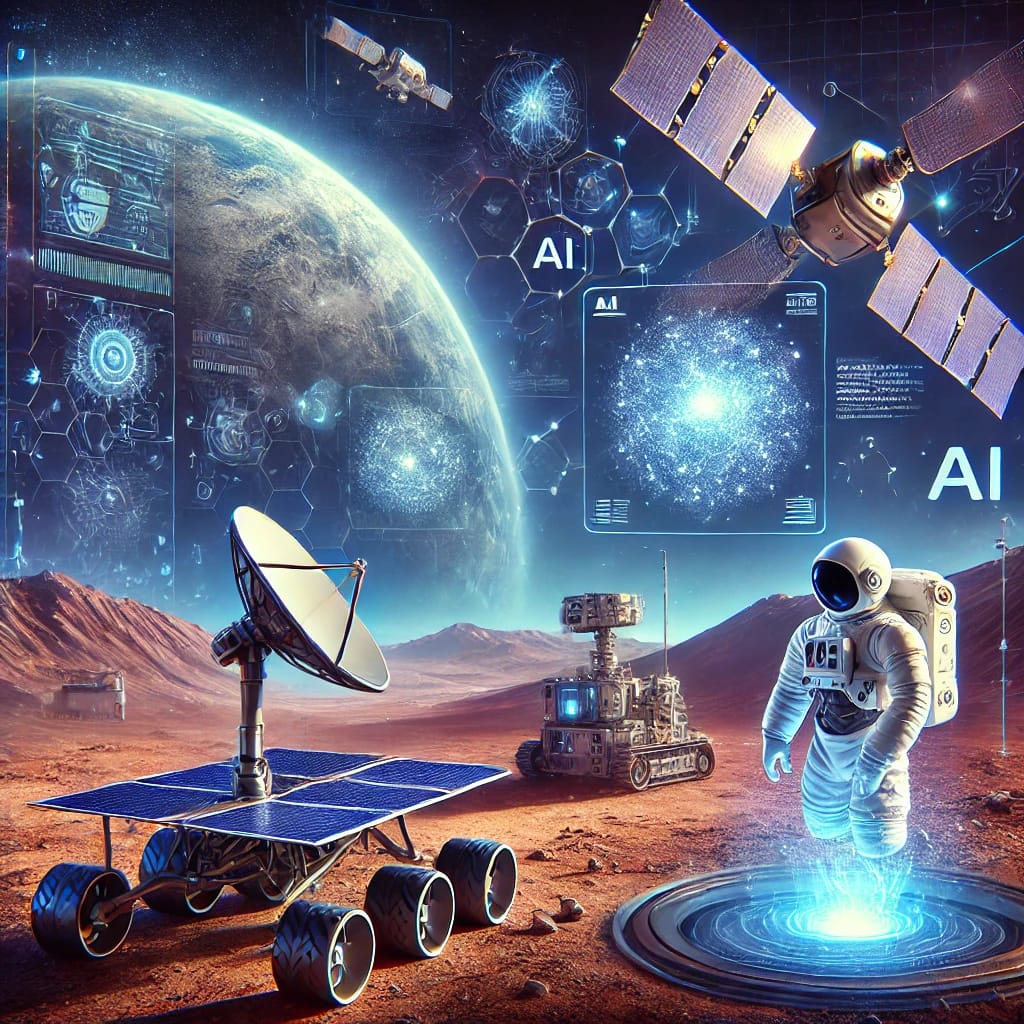
- This course explores AI applications in space exploration, from satellite data analysis to autonomous spacecraft navigation. Designed for aerospace engineers and space scientists, the course will equip students with AI skills to innovate in the space industry.
- Level: Intermediate
- Prerequisites: Background in aerospace engineering or space science.
- Assessments: Micro Assessment weekly, Full Assessment in the final week.
Week 1-AI in Satellite Data Processing and Analysis
Learning Outcome Learn how AI is used to analyze satellite imagery and environmental data1.1 AI-powered image analysis for earth observation and remote sensing.
1.2 Using deep learning for detecting and tracking objects in space.
1.3 AI for analyzing large datasets from satellite missions.
Practical Component
Build an AI model to process satellite imagery for environmental monitoring
Week 2-AI in Spacecraft Navigation and Autonomous Control
Learning Outcome Understand AI applications in autonomous spacecraft navigation and control systems2.1 AI for autonomous spacecraft path planning and trajectory optimization.
2.2 Machine learning for real-time spacecraft diagnostics and control.
2.3 Using AI in space rover navigation and exploration.
Practical Component
Implement an AI solution for autonomous navigation in space.
Week 3-AI for Space Mission Optimization and Resource Management
Learning Outcome Learn how AI enhances space mission planning, resource allocation, and operations3.1 AI for optimizing mission schedules and resource usage.
3.2 Using AI for predictive maintenance in spacecraft.
3.3 Machine learning models for space mission risk assessment.
Practical Component
Develop an AI model to optimize resources for a space mission.
Week 4-AI for Astrophysics and Cosmic Exploration
Learning Outcome Explore how AI helps in discovering new celestial bodies and analyzing space phenomena4.1 AI for analyzing cosmic data and simulating space phenomena.
4.2 Neural networks in detecting exoplanets and star systems.
4.3 Using AI for space anomaly detection and exploration
Practical Component
Use AI to analyze astronomical data and identify potential exoplanets
Week 5-AI for Space Safety and Collision Avoidance
Learning Outcome Understand AI's role in enhancing space safety and avoiding collisions5.1 AI for satellite collision detection and avoidance.
5.2 Machine learning for space debris tracking and management.
5.3 Using AI for real-time hazard detection in space operations.
Practical Component
Build an AI model for satellite collision prediction and avoidance.
Week 6-Capstone Project and Assessment
Learning Outcome Develop an AI solution for a space-related challenge6.1 Implement an AI solution for satellite data processing, autonomous navigation, or space mission optimization.
6.2 Peer assessment and feedback.
6.3 Final project presentation and evaluation.
Practical Component
Present a space-focused AI project demonstrating its impact on space exploration and mission success.