A Novel Platform Software Tool for Facilitating New Drug Discovery
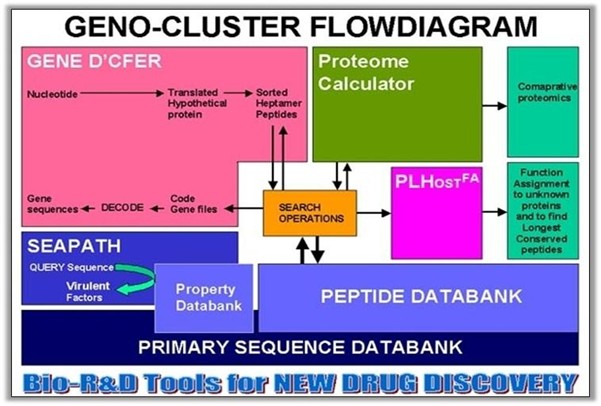
A suite of software programs — GENE'D'CFER, PROTEOME CALKULATOR, PLHOSTFA, and SEAPATH — ported into a LINUX cluster to harness enhanced computational power for prediction of prokaryotic genes, functional assignment of encoded products, and identification of adhesins using Artificial Neural Network based algorithms.
GeneD'cfer
Gene PredictionProteome Calkulator
Comparative ProteomicsPLHostFA
Function AssignmentSEAPATH
Adhesin PredictionPRIMARY SEQUENCE DATABANK
PEPTIDE DATABANK · ANN-Powered · LINUX Cluster
The availability of complete sequences of more than 280 genomes provides novel opportunities for in depth understanding of various biological phenomena through in silico comparative genomics. Identification of novel genes, assignment of function to gene products and their evaluation as potential drug targets is considered to be of prime importance.
We have developed a suite of software programs GENE'D'CFER, PROTEOME CALKULATOR, PLHOSTFA, and SEAPATH and porting them into LINUX cluster to harness the enhanced computational power that aids in the prediction of prokaryotic genes, functional assignment of encoded products, identification of adhesins with the help of Artificial Neural Network based algorithms.
Prokaryotic Gene Identification Using ANN & Peptide Library
We have developed a generic and versatile new approach, designated Gene'D'cfer (GDC), for prokaryotic gene identification. Unlike other existing methods, this approach employs peptides as markers for protein coding DNA sequences. GDC determines candidate genes among all possible ORFs in a given DNA sequence through the use of Artificial Neural Network (ANN) trained on a set of known peptide library. Potential ORFs are ranked according to a scoring scheme based on the abundance and distribution pattern of heptapeptides along the ORF. ORFs identified by GDC can be overlaid with other features using complementary software programs for ribosomal binding sites, promoter sequences, transcription start sites, or codon biases for further examination. An analysis of 18 completely sequenced prokaryotic genomes has been carried out to demonstrate the capabilities of GDC. In addition, GDC has been applied on various strains of SARS virus and 4 new genes were predicted.
Rapid Comparative Proteomics via Peptide Library Approach
Delineating Conserved and Variable regions in sequences is of fundamental biological importance. Conserved regions are strong indicators for phylogenetically conserved functional roles whereas variable regions are generally implicated in auxiliary roles, often related to specific cases. The traditional approaches towards this objective involve comparing the homologous sequences using multiple sequence alignment algorithms. This approach although sound in theory is limited in terms of its speed and is not suited for high capacity. Although this limitation can be overcome in principle using powerful computers with enlarged memory, the results need careful scrutiny by the user. In most cases, users simply wish to know, in a first pass, the conserved and variable regions. PROTEOME CALKULATOR meets this need by offering a rapid approach to compare all the proteins (proteome) of a species with proteomes of other species using a peptide library approach.
ANN-Based Adhesin Prediction at 97.4% Accuracy
Prediction of surface proteins involved in virulence from the complete sequences of proteomes of pathogens can greatly facilitate the development of anti-infectives towards eradicating infectious diseases. ANN was used to develop SEAPATH, which predicts the probability of a protein being an adhesin (Pad) based on 105 compositional properties of a sequence. SEAPATH draws upon the base algorithm SPAAN, which had optimal sensitivity of 89% and specificity of 100% and could identify 97.4% of adhesins from a wide range of bacterial pathogens causing a broad range of diseases in humans and other hosts. In the case of Severe Acute Respiratory Syndrome (SARS) associated Human corona virus, the spike glycoprotein, and nsps (nsp2, nsp5, nsp6 and nsp7) of SARS virus were identified with adhesin-like characteristics and offer new leads for rapid experimental testing.
Developed by CSIR-IGIB, supported by Indian Centre for Social Transformation — all holding US patents and licensed by top institutions including IIT and IICB.
▼ Click any tool heading to expand or collapse detailsProkaryotic Gene Identification Tool
This software tool for predicting genes in Prokaryotes determines gene candidates amongst all possible ORFs of a given DNA sequence by using a peptide library and an Artificial Neural Network (ANN).
Protein Function Assignment Tool
This software tool is based on invariant peptide motif signatures and assigns putative functions to unknown proteins. It is a complementary tool to BLAST and is an auto-annotator unlike BLAST.
Comparative Proteomics Tool
Comparative Proteomics play a vital role in analyzing protein sequence of various organisms. It helps in understanding the disease process, develop new biomarkers for diagnosis and accelerate drug development.
Adhesin Prediction Tool
Prediction of surface proteins involved in virulence from the complete sequences of proteomes of pathogens can greatly facilitate the development of anti-infectives towards eradicating infectious diseases.
Especially valuable for companies into Re-engineering Vaccines, new drug discovery, or finding druggable drug targets, or for the following needs:
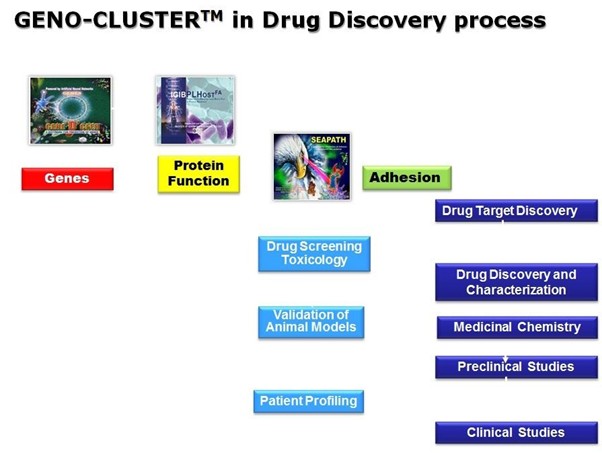
Scientists rely on bioinformatics during every step of the drug discovery process in an effort to comprehend biological and disease mechanisms, identify new targets and to select and design novel drugs. But while methods for sequencing, measuring expression, and assessing structure have achieved high-throughput capacity via automation, the means by which data is analyzed are lagging behind.
The practice of studying genetic disorders is changing from investigation of single genes in isolation to discovering cellular networks of genes, understanding complex interactions, and identifying their role in disease.
As a result of this, a whole new age of individually tailored medicine will emerge. Bioinformatics will guide and help molecular biologists and clinical researchers to capitalize on the advantages brought by computational biology.
On the horizon: more effective and affordable medicines, new research that leads to treatment and cures, and healthcare decisions based on a person's genes.
Collaborations: between small biotech companies and larger drug development organizations, such as pharmaceutical companies, can be mutually beneficial. Under such agreements, smaller companies can gain financing to carry on with their R&D programs, while the bigger company will supplement its new drug pipeline with an innovative product.
Scientists rely on bioinformatics during every step of the drug discovery process in an effort to comprehend biological and disease mechanisms, identify new targets and to select and design novel drugs. But while methods for sequencing, measuring expression, and assessing structure have achieved high-throughput capacity via automation, the means by which data is analyzed are lagging behind.
NMITLI is the largest public-private-partnership R&D initiative of the Govt. of India. In a short span of time, the programme has several significant achievements to its credit. These include the TB molecule, herbal formulations for Psoriasis, low cost computer, weather forecast system, Bioinformatics products etc, with GENO-CLUSTER being one of them that has been developed by Institute of Genomics and Integrative Biology (IGIB) and the Council of Scientific and Industrial Research (CSIR) and now further development and hosting it is supported by Indian Centre for Social Transformation (Indian CST) a public charitable Trust.
All the applications hold US patents, and have been installed in the leading academic and research institutions all over India and across the world. The software has already proved to be of tremendous use in the discovery of novel genes of the SARS virus and has several papers credited to its findings.
For more details and real time solutions demo experience visit www.indiancst.in. Academic access to CSIR-IGIB data servers is free. Contact CSIR-IGIB or Indian CST for commercial use.
Visit www.indiancst.inCSIR-IGIB data servers free for academic institutions
Contact CSIR-IGIB or Indian CST for commercial use
Training on indigenous bioinformatics tools
Joint research with CSIR-IGIB & Indian CST